


Villas and bungalows are some of the most-loved housing stock in the country, and also some of the most consistently damp. It’s not bad luck — it’s how they were built, decades before insulation and vapour barriers were standard practice. Many of these moisture issues eventually lead to mould and condensation problems in older homes.
Why older homes have a different moisture profile
Most villas sit on timber piles with an open subfloor that was never properly ventilated or sealed with a moisture barrier. Combine that with single glazing, weatherboard cladding with gaps, and walls that were never insulated, and you get a home that’s simultaneously draughty and damp — cold air getting in, but moisture also struggling to leave in a controlled way.
The subfloor is often where it starts
Ground moisture rises into an unventilated or poorly ventilated subfloor and works its way up into the living spaces through floorboards, adding to the moisture load the rest of the house has to deal with. A ground moisture barrier and improved subfloor airflow is frequently the single most useful thing we recommend for a villa before even talking about a ceiling-based ventilation system.
Positive pressure ventilation suits character homes well
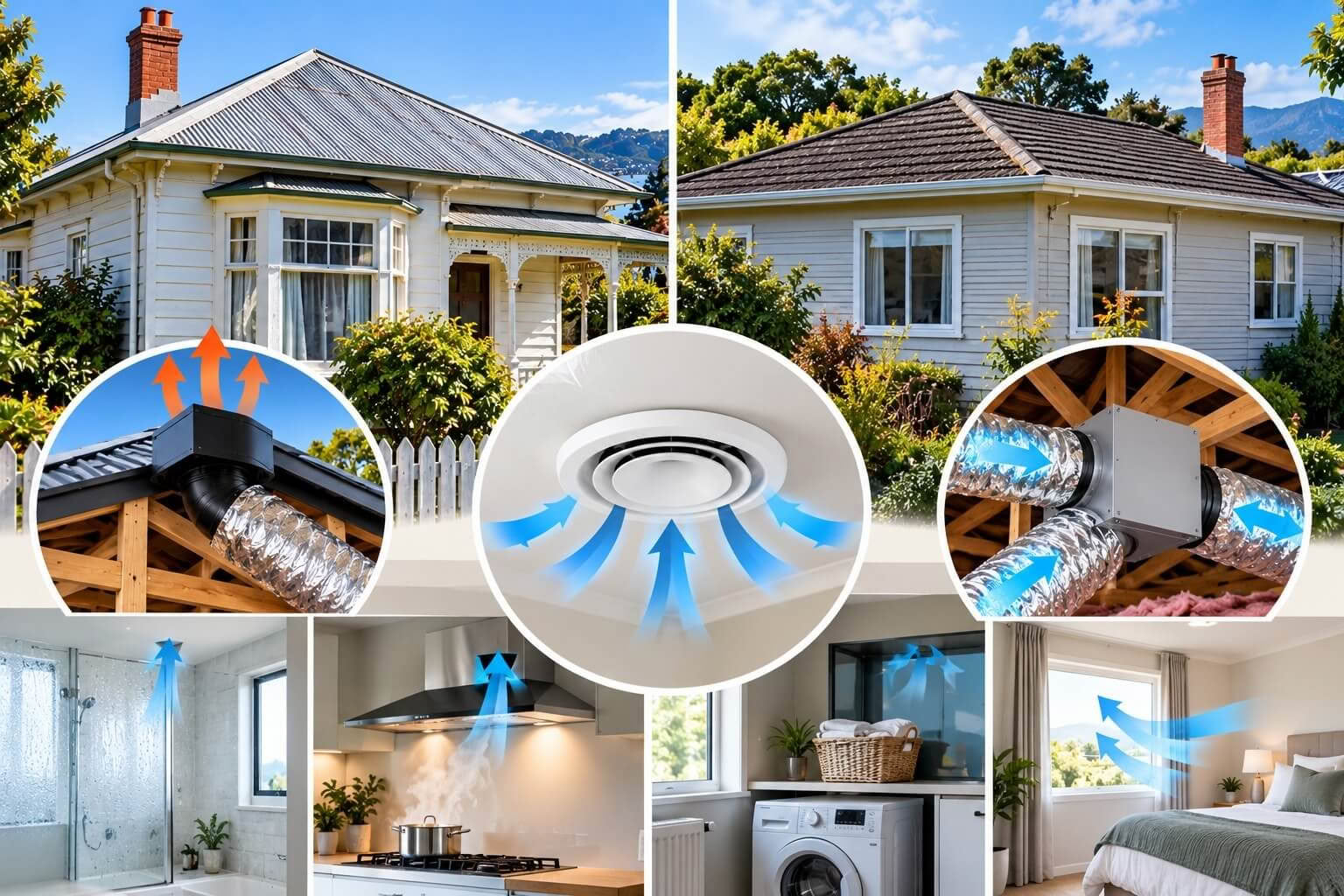
Because a positive pressure system draws air from the existing roof cavity and pushes it through a single ceiling diffuser, it’s usually far less invasive to install in a villa than a heat recovery system, which needs a more extensive network of ducting run through a ceiling that’s often lath and plaster rather than a modern flat gib ceiling with easy cavity access.
Working with the character features, not against them
A good installer plans duct and diffuser placement around existing ceiling roses, cornices and stud layout rather than the other way around. It’s a slower, more careful job than a new-build install, and it should be quoted and scheduled that way.
What we typically recommend
For most villas and bungalows we assess: a ground moisture barrier and improved subfloor ventilation first, a positive pressure ventilation system through the roof space second, and extraction ducted outside in the bathroom and kitchen to meet Healthy Homes requirements if the property is rented. Every home is different, which is why we start with a free home assessment rather than a standard package.
Frequently Asked Questions
Why are old villas in NZ more prone to dampness?
Older villas were built before insulation and moisture barriers became standard, so ground moisture and condensation can build up more easily.
Is positive pressure ventilation a good choice for character homes?
Yes. Positive pressure ventilation is often a good fit for villas because it can be installed with minimal impact on original ceilings and character features.
Does subfloor ventilation really reduce moisture?
Yes. Improving subfloor ventilation helps remove damp air from beneath the house and reduces moisture rising through timber floors.
Can ventilation help reduce condensation on windows?
Yes. A good ventilation system lowers indoor humidity, which helps reduce condensation on windows and the risk of mould growth.
How do I choose the right ventilation system for an older NZ home?
The best system depends on your home’s layout, roof space, subfloor condition, and overall moisture levels, so a home assessment is usually the best starting point.